District Cooling From the Pacific: A Targeted Efficiency for Oʻahu
Summary
The article discusses the potential of seawater air conditioning in Oʻahu, highlighting its integration into the island's electrified energy system. The authors emphasize the importance of targeted efficiency in enhancing sustainable energy solutions for the region.
Key Insights
How does seawater air conditioning (SWAC) work, and why is it particularly suitable for Oʻahu?
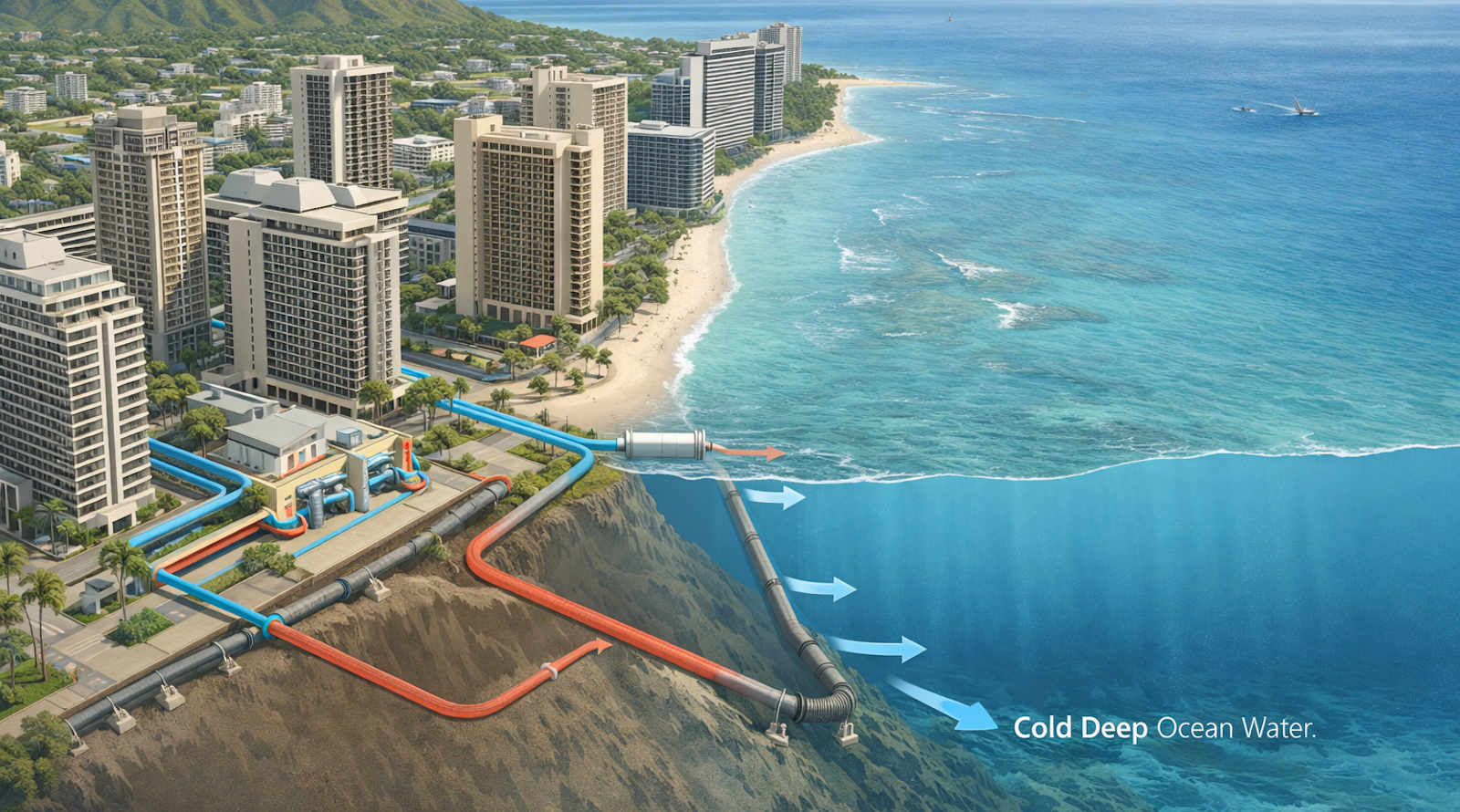
Seawater air conditioning works by pumping cold deep seawater (typically 44-45°F from depths of 1,600-1,800 feet) through titanium heat exchangers that chill fresh water in a closed-loop system. This chilled fresh water is then distributed to buildings for cooling, while the slightly warmed seawater is returned to the ocean. SWAC systems operate at approximately 15% of the power consumption of conventional chillers. Oʻahu is particularly well-suited for this technology because of the proximity of deep, cold ocean water to areas of high population density, combined with the island's reliance on imported oil for electricity generation, making renewable cooling solutions especially valuable.
What are the main components of a SWAC system, and why is titanium used in heat exchangers?
A SWAC system consists of four main components: deep seawater intake and return pipelines, titanium heat exchangers, seawater and freshwater pumps, and a distribution system for chilled fresh water. Titanium is used in heat exchangers because it eliminates corrosion concerns that would otherwise occur when seawater comes into contact with the cooling system. The heat exchanger is critical because it allows heat from buildings to be transferred to the cold seawater while ensuring that fresh water and seawater never mix, preventing corrosion damage to building infrastructure and maintaining system integrity.